
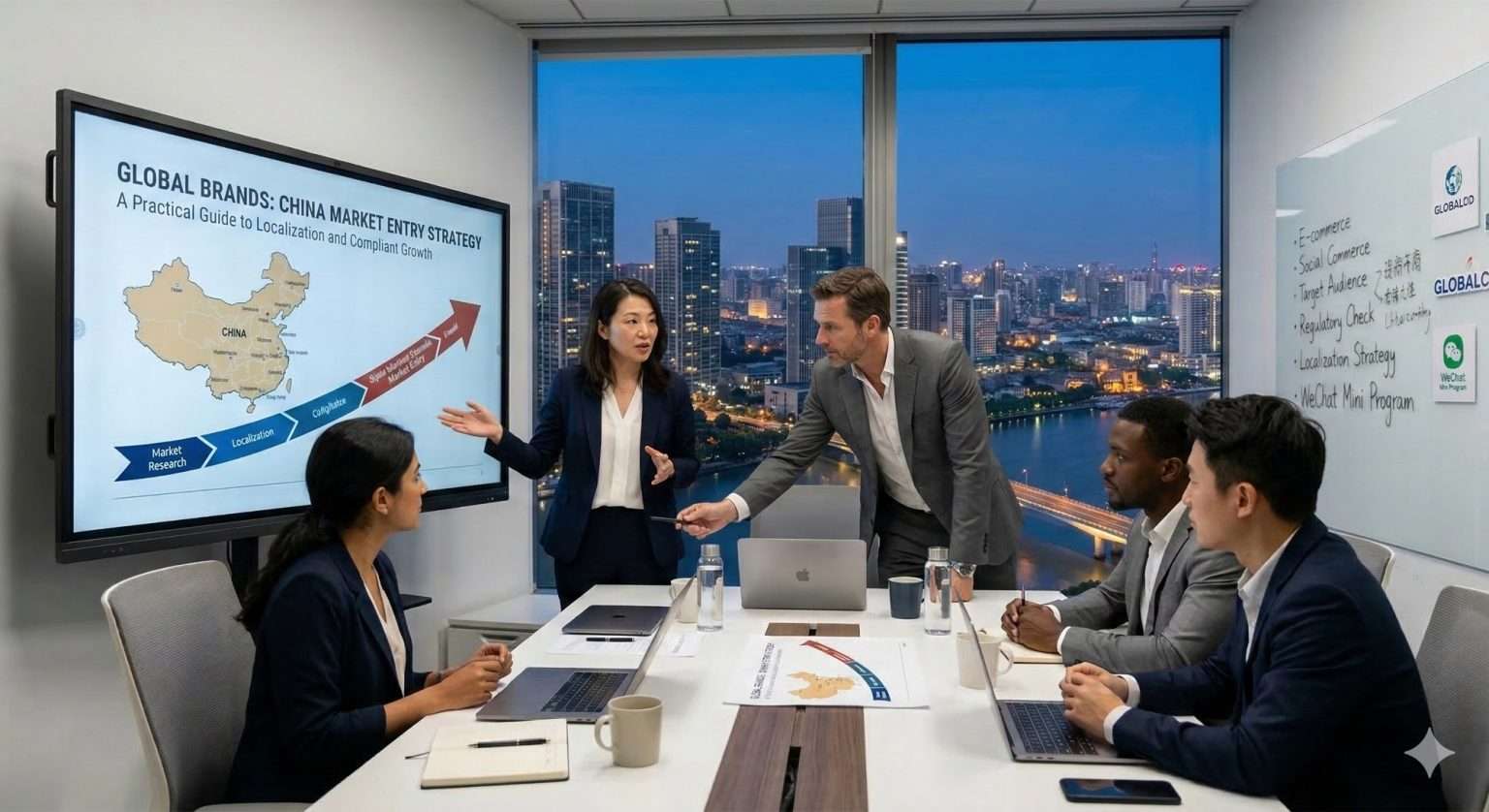

China is the world’s second-largest economy and its most dynamic digital consumer market — drawing thousands of international brands every year. Yet this market of 1.4 billion people, vast regional complexity, and a uniquely self-contained digital ecosystem is simultaneously one of the world’s greatest commercial opportunities and one of its most demanding proving grounds.
Research from the European Union Chamber of Commerce in China notes that for two decades, European brands succeeded in China on the strength of rapid market entry and the goodwill of a “Western premium.” That era is over. Chinese consumers are more sophisticated than ever, national pride plays a growing role in purchasing decisions, and local competition has intensified dramatically. The “cultural blind spots” that brands once overlooked are now costing them market share, consumer loyalty, and reputation.
For international brands planning to enter or expand in China in 2026, heritage and product quality alone are no longer enough. What separates the winners is a systematic localization strategy — one that spans market research, product adaptation, and deep integration into China’s digital marketing ecosystem, alongside rigorous management of compliance risk. This guide draws on real-world case studies from consumer goods and luxury sectors to give brands a practical, actionable roadmap.
I. Market Research and Positioning: Understanding China’s “Multiple Universes” of Consumption
1. Regional and generational divides: Moving beyond the “single market” assumption
China’s market complexity starts with its extraordinary fragmentation across regions and demographics. Consumers in China’s eastern coastal cities prioritize brand experience and lifestyle signaling; those in inland cities are considerably more price-sensitive. Northern consumers place high value on “mianzi” (face) in social contexts and are willing to pay a premium for status-associated products, while southern consumers tend to be more pragmatic, focused on value for money.
The generational divide is equally significant. Gen Z (born 1995–2009) places a premium on experience and emotional resonance, readily paying for “emotional value.” Silver-economy consumers (60+), while price-conscious, show strong spending potential in health, travel, and wellness. The new middle class navigates a constant balance between quality and affordability — and is driving the rise of “ping ti” culture: affordable alternatives that don’t compromise on aspiration.
Practical Recommendations:
- Tiered market strategy: Begin with pilot launches in Tier 1 cities (Beijing, Shanghai, Guangzhou, Shenzhen, Chengdu) to build brand awareness, then expand to lower-tier cities via e-commerce platforms (Tmall, JD.com) and social commerce (Pinduoduo, Douyin).
- Precision consumer profiling: Go beyond age and gender segmentation. Use social listening tools to analyze lifestyle patterns and surface genuine, unarticulated consumer needs.
2. A restructured competitive landscape: The rise of local brands and the “Guochao” wave
A 2024 Kantar study found that 72% of Chinese consumers are willing to pay a premium for deeply localized design — yet only 14% feel international brands have actually delivered on this. This means overseas brands are no longer just competing with other global players; they are up against a generation of local brands that understand Chinese consumer psychology intuitively, deploy Guochao (national trend) aesthetics fluently, and iterate their products at speed.

International brands must abandon any sense of inherent superiority and reposition around an “In China, For China” mindset.
Practical Recommendations:
- Build a local insight team: Assemble teams that combine global perspective with genuine local market knowledge. Prioritize hiring content creators and marketing strategists who are deeply embedded in China’s social media ecosystem.
- Dynamic competitive analysis: Look beyond direct category competitors. Beauty brands, for instance, should monitor ingredient innovation from local skincare players; food brands should track how new-style tea beverage brands are expanding into adjacent lifestyle occasions.
II. The Three Dimensions of Localization: Product, Culture, and Communication
1. Product localization: From “global standardization” to “structural innovation”
A common misconception: Adding Chinese visual motifs — dragons, red packaging — is not localization. Kantar’s data is clear: successful localization requires rebuilding from the ground up, involving local management, distributors, and consumers from the earliest stages of product development, and using testing, feedback loops, and collaboration with local creators to embed the brand into the market.
Industry Case Studies:
- Consumer goods: KFC initially launched in China without a breakfast offering. After observing local consumer habits, it developed a localized breakfast menu featuring soy milk and Chinese crullers (youtiao), and launched the iconic “Old Beijing Chicken Roll.” China is now KFC’s largest global market.
- Beauty & skincare: Estée Lauder adapted its formulations and messaging for Chinese skin concerns — emphasizing anti-aging ingredients like ginseng and dong quai root extract that carry strong cultural resonance — and used auspicious red and gold packaging to connect with local aesthetic sensibility.
- Luxury food: Häagen-Dazs introduced ice cream mooncakes timed to the Mid-Autumn Festival — preserving its premium core product while embedding it in a distinctly local occasion. The result became a cult item among urban tastemakers.
Practical Recommendations:
- Participatory product development: Launch campaigns on Xiaohongshu and Douyin — inviting target consumers to vote on formulations, packaging designs, or flavor profiles.
- Contextual product innovation: Develop products specifically for China-specific consumption contexts: Spring Festival gift sets, single-serve formats for solo consumers, functional food products addressing the “punk wellness” trend.
2. Cultural localization: Building local narratives, not just local translations
One of the most common — and costly — mistakes international brands make is directly translating global campaign assets for the Chinese market. Effective marketing in China requires more than a language switch; it demands the construction of a storytelling system that genuinely resonates with local culture.
When Coca-Cola entered China in 1979, it worked with then-Minister of Foreign Trade Li Qiang to orchestrate a PR moment: placing radios disguised as Coke cans in a Beijing beverage shop for customers to take home for free. The creative news event generated immediate buzz and established the brand’s presence. This kind of culturally embedded, locally conceived activation is what separates brands that break through from those that merely show up.
Key Strategies:
- Speak Gen Z’s language: Incorporate internet slang, Guochao references, and culturally specific humor into youth-facing communications — but with a light touch. Forced adoption of trending language reads as inauthentic and patronizing.
- Lead with ESG and sustainability: Starbucks in China introduced “sludge straws” (straws embedded with coffee grounds) and wooden cutlery as part of its sustainability positioning — a move that resonated strongly with younger consumers who actively factor environmental values into their brand choices.
- Commit to festive marketing: Go beyond Singles’ Day and Lunar New Year. Build meaningful brand presence around Qixi (Chinese Valentine’s Day), Mid-Autumn Festival, and 618 — developing limited-edition products and original content tailored to each occasion.
3. Communication localization: From brand monologue to social dialogue
Chinese consumers no longer follow a brand-education-to-purchase path. Before making a buying decision, they habitually search Xiaohongshu for authentic reviews, watch how-to tutorials on Douyin, and consult friends in WeChat groups. Brands must build a full-funnel communication system spanning discovery, conversion, and retention.
Practical Recommendations:
- KOL/KOC matrix strategy: Structure your influencer approach across three tiers: top-tier celebrities and major KOLs to establish brand credibility; mid-tier creators for specialist product reviews; and everyday KOCs (Key Opinion Consumers) for authentic word-of-mouth. On Xiaohongshu in particular, KOCs consistently outperform KOLs on conversion precisely because they’re perceived as more trustworthy.
- Platform-native content: Xiaohongshu content should be detailed, information-rich, and visually polished; Douyin content needs an emotional hook within the first three seconds; WeChat is suited to deeper brand storytelling. Each platform requires bespoke content — never repurpose.
III. China’s Digital Marketing Ecosystem: Content, Social, and E-Commerce Working Together
1. Social media platform strategy: Differentiated positioning across six key platforms
China’s social media landscape is highly fragmented, with each platform serving distinct user behaviors and content preferences. Here’s how to position your brand across the ecosystem:
| Platform | Core Function | User Profile | Brand Strategy Focus |
|---|---|---|---|
| Private domain & deep content | All age groups; strong social bonds | Brand storytelling via Official Accounts + Mini Program commerce + community membership management | |
| Xiaohongshu (RED) | Discovery & lifestyle inspiration | Young women in Tier 1–2 cities; high spending power | KOC authentic reviews; keyword SEO; brand account content library |
| Douyin | Short video & livestream commerce | Primarily young users; strong penetration in lower-tier cities | Challenge campaigns; in-feed ads; brand self-broadcast + KOL livestreams |
| Trending topics & PR management | Broad audience; entertainment & current affairs | Hot search topic marketing; celebrity/KOL partnerships; crisis PR response | |
| Kuaishou | Lower-tier markets & everyday life | Tier 2–3 cities and rural users | Relatable content; community-driven commerce; livestream sales |
| Bilibili | Gen Z interest communities | Young users; anime, knowledge & culture content | Deep UP creator collaborations; quality long-form video; bullet comment interaction |
Cross-platform synergy strategy: Consumer journeys routinely span multiple platforms. A typical path might look like this: a Douyin short video sparks initial interest → the consumer searches for detailed reviews on Xiaohongshu → discovers the brand’s Mini Program via WeChat search → completes the purchase and shares on Moments. Brands must ensure their content across platforms is coherent and complementary — not simply duplicated.
2. Content strategy: Building “zhong cao” (seeding) infrastructure
In China, “discover first, buy later” has become the dominant consumer decision-making pathway. “Zhong cao” — the practice of planting a desire to purchase through content — requires sustained, long-term content investment, not a single campaign push.
- Deep Xiaohongshu cultivation: Maintain a dedicated brand account and publish regular, genuinely useful content — skincare tutorials, styling guides, “expert tips.” Partner with mid-tier KOLs for product reviews and actively encourage authentic UGC to build organic word-of-mouth. Louis Vuitton’s post-show “resee” livestream on Xiaohongshu drew 470,000 viewers.
- Douyin interest-based commerce: Leverage the platform’s interest-matching algorithm to reach potential consumers through short-form content. Nike’s branded livestream variety show on Douyin accumulated over 6 million views and gained 150,000 new followers.
- WeChat private domain cultivation: Use incentives to migrate public traffic from Douyin and Xiaohongshu into WeChat-based brand communities or WeCom groups — creating a re-engageable owned audience that doesn’t require perpetual paid media to reach.
3. E-commerce channel strategy: From cross-border entry to full local presence
International brands typically move through three phases as they build their e-commerce presence in China:
- Testing phase (0–6 months): Enter via cross-border e-commerce channels such as Tmall Global or JD Worldwide. Use bonded warehouse models to limit inventory risk while validating product-market fit quickly.
- Deepening phase (6–18 months): Open a Tmall flagship store or JD direct store; establish local warehousing and logistics; participate in major promotional events such as Double 11 and 618.
- Full omnichannel phase (18 months+): Integrate online and offline; expand into emerging channels including Douyin Shop and Xiaohongshu Shop to complete the content-to-commerce loop.
Channel selection by category: Luxury and high-ticket products should prioritize Tmall Luxury Pavilion and branded Mini Program storefronts, emphasizing brand experience and service quality. FMCG and mass-market brands should pursue full-channel coverage with particular attention to the scale and growth velocity of Pinduoduo and Douyin Shop.
IV. Compliance and Risk Management: The Non-Negotiables
1. Legal and regulatory compliance framework
China’s regulatory environment for advertising, data privacy, and product safety is tightening, and the pace of change is accelerating.
- Advertising law compliance: Avoid absolute superlatives such as “best,” “number one,” or “most.” Efficacy claims in healthcare, food, and cosmetics categories must be substantiated with scientific evidence and approved through the relevant regulatory bodies.
- Data privacy: China’s Personal Information Protection Law (PIPL) requires brands to obtain explicit consent before collecting and using personal data, and mandates that data be stored locally within China.
- Cross-border e-commerce compliance: Familiarize yourself with the E-Commerce Law and the General Administration of Customs’ regulations on cross-border retail imports. Ensure all products fall within the Positive List and are correctly declared.
Healthcare and medical device brands face particularly stringent oversight — partnering with local regulatory specialists for product registration, certification, and approval is essential. Novartis’ establishment of China-based R&D centers and Medtronic’s clinical collaborations with local hospitals are both strong examples of building market trust within a compliance-first framework.
2. Reputation monitoring and crisis management
Information travels at extraordinary speed across Chinese social media. Brands need a 24/7 monitoring and response capability.
- Prevention: Conduct regular audits of all advertising assets and social media content to identify potential cultural sensitivities — including map accuracy, historical references, and anything that could be perceived as disrespectful to ethnic or national sentiment.
- Rapid response: Establish a crisis communications protocol. When negative sentiment surfaces, respond swiftly through official Weibo and WeChat channels. Speed and sincerity are both expected.
- Long-term reputation building: Invest consistently in CSR programs aligned with your brand positioning — Ford’s environmental awards, BMW’s children’s road safety program — to build a reservoir of goodwill that provides resilience when reputational challenges arise.
V. Playing the Long Game: From Traffic Acquisition to Brand Equity
1. Resist short-termism; invest in long-term relationships
Many international brands enter China with an excessive focus on short-term ROI — leaning on aggressive discounting or paid traffic acquisition — and find themselves trapped in a cycle where sales disappear the moment they stop spending. The brands that have built enduring positions in China — Coca-Cola, Volkswagen — committed to long-term brand building from day one and compounded that investment over decades.
- Build a content asset library: Produce brand documentaries, podcasts, and long-form video that have genuine depth and aesthetic quality — building a “content bank” of durable assets rather than one-time campaign material.
- Invest in private domain: Redirect a portion of performance marketing budget toward private domain cultivation — membership programs, community building — to reduce dependency on paid media over time.
- Develop local talent and empower them: Build out a China-based management and creative team and give them real decision-making authority. Strategies that require sign-off from global headquarters for every execution will always arrive too late for China’s pace.
2. Government relations and corporate social responsibility
In China, constructive relationships with government at various levels have historically been a meaningful enabler of brand growth — as demonstrated by Volkswagen and Coca-Cola in the early decades of China’s reform era. Brands should:
- Engage in industry dialogue: Participate in industry standards development where possible, drawing on international experience to contribute to regulatory frameworks while earning a stronger voice in the ecosystem.
- Practice purposeful CSR: Develop CSR programs that align authentically with your brand’s core positioning: healthcare brands investing in public health education; automotive brands funding road safety programs.
- Integrate ESG into brand storytelling: Embed environmental and social commitments into your brand narrative — Starbucks’ compostable “sludge straws” and reusable cup initiatives are strong examples of sustainability storytelling that feels genuinely integrated rather than performative.

Conclusion
There is no universal formula for succeeding in China. What history does show is that the brands with the most enduring success — Coca-Cola, which entered in sync with China’s reform and opening-up in 1979; KFC, which opened its first Beijing location in 1987; Estée Lauder and lululemon, which have won Gen Z in recent years through genuine localization — all share a common thread: respect for the market, a genuine understanding of the culture, and sustained commitment over time.
China’s market in 2026 is more mature and more complex than at any point in history. Consumer sovereignty is stronger, local brand competition is fiercer, and the digital ecosystem continues to evolve at pace. International brands must let go of any cultural superiority and approach the market with what might be called a “student mindset” — a genuine curiosity about what Chinese consumers actually want, rather than what global headquarters assumes they should want. They must resist the temptation of superficial cultural gestures and invest in the structural localization that enables brands to truly belong. And above all, they must adopt a long-term perspective, treating China as a strategic growth engine rather than a short-term revenue opportunity.
As the European Union Chamber of Commerce in China advises: don’t rest on past achievements. Stay present, keep earning trust, and build the kind of genuine local relationships that compound over time. The brands that will win in China are those that commit to developing genuinely local teams, building genuinely local brands — and showing up, consistently, for the long haul.
At GAB China, we help global brands navigate China’s fast-evolving digital landscape — blending international perspective with deep local insight. If you’re planning your next move in China, we’d love to talk.
Sources
- Hefei Commerce Bureau — European brands adapt to China’s evolving market landscape
- International PR & China PR Network — Marketing and PR strategies for foreign enterprises entering China
- PLTFRM — How can overseas brands develop a precise China market entry strategy?
- PLTFRM — Cracking China’s social media ecosystem: Winning strategies for overseas brands (Part 1)
- Digitaling / PLTFRM — Cracking China’s social media ecosystem: Winning strategies for overseas brands (Part 2)