
China’s luxury market is recovering — and the brands positioned to capture that recovery are not necessarily the biggest or the oldest. They are the ones that have read the shift in consumer sentiment correctly and built the right digital infrastructure to act on it.
Roland Berger’s latest report projects 3–6% growth for China’s luxury market in 2026, with a sustained 5–7% trajectory over the following five years. Online channels are leading the charge: Tmall Luxury saw double-digit growth in 2025, with Q3 transaction volume up more than 40% year-on-year. OMEGA, ALAÏA, and Vivienne Westwood all opened official flagship stores on the platform during this period. But this is not a simple rebound. The underlying logic of luxury consumption in China has changed, and brands that respond with yesterday’s strategy will find themselves competing for a market that no longer exists.
This article examines what that shift looks like, what AI and digital tools are making possible, and what it means in practice for luxury brands navigating China in 2026.
I. What’s Actually Driving the Recovery
1. Consumers have moved on from status signaling
The Chinese luxury consumer of 2026 is not the same person as five years ago. Accenture research shows that more than 80% of high-net-worth consumers now expect something beyond the product itself — they want to feel understood, recognized, and served as individuals. On Xiaohongshu, searches for “quiet design” and “personal style” grew 83% year-on-year in 2024. The era of conspicuous consumption — buying for social signaling — has given way to what might be called emotional resonance consumption: buying for self-expression, personal meaning, and the quality of the experience itself.
For luxury brands, this is both a challenge and an opportunity. It demands far more precise consumer intelligence than traditional demographic profiling can provide — and that is precisely where AI delivers its most meaningful value.
2. Online channels are opening up new markets
One of the most significant structural shifts in China’s luxury market is the geographic diversification of online luxury spending. Tmall Luxury’s fastest-growing consumer base is not in Shanghai or Beijing — it’s in Sichuan, Henan, and other provinces where luxury retail has historically had little physical presence. Tier 3 to 6 city consumers are accessing luxury for the first time through online channels, and the overlap between online and offline luxury shoppers remains remarkably low.
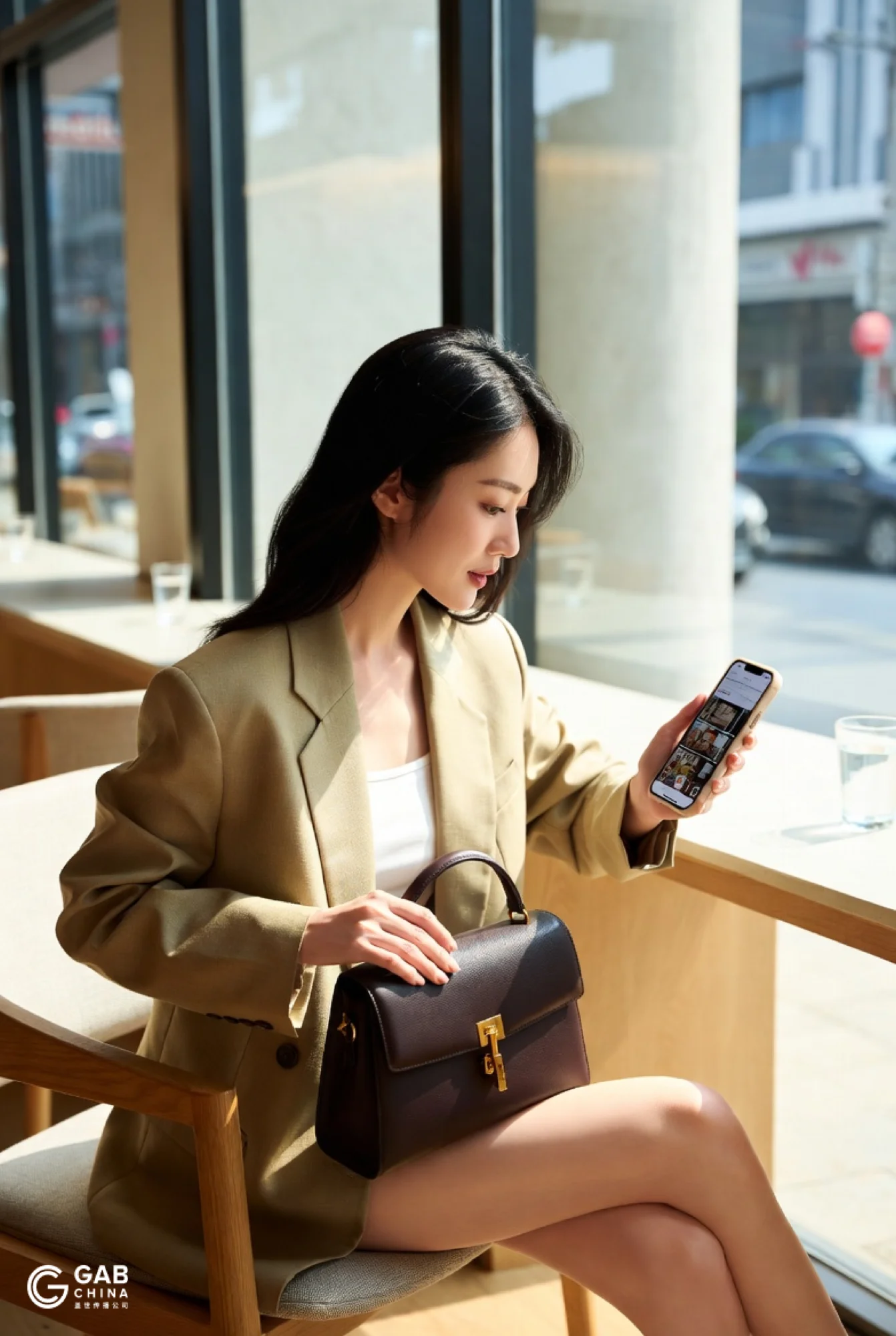
This means that a well-executed digital strategy in China is not simply a complement to the physical store network — it is the primary means of reaching a substantial and growing segment of the luxury market.
3. The value tier is polarizing
Boston Consulting Group’s analysis makes the strategic implication clear: the “light luxury” tier — consumers spending less than €2,000 annually on luxury — is contracting rapidly. Meanwhile, spending among the top tier of high-net-worth consumers continues to grow. Brands that built their China strategy around aspirational mass-market expansion now face a structural challenge. The brands that will outperform are those pivoting to deep, personalized cultivation of their highest-value customer base — and AI-powered CRM is the tool that makes that pivot operationally feasible at scale.
II. Four Ways AI Is Reshaping the Luxury Consumer Relationship
1. Consumer intelligence: from broad labels to living profiles
High-net-worth consumers don’t behave the way demographic segments predict. The same individual may have very different preferences at a weekday business dinner versus a weekend social occasion. Traditional segmentation — age, income bracket, city tier — captures none of this nuance. AI changes that by integrating platform behavioral data, brand membership data, and real-time interaction signals into dynamic, multi-dimensional consumer profiles that update continuously.
Tmall Luxury’s AI tools analyse consumer profiles across three dimensions — attributes, behavioral preferences, and category interests — to provide brands with precise targeting recommendations, identifying and reaching the top 2% of premium consumers with significantly less waste. Huawei’s Zhihong Dongneneng platform takes a different approach: using Harmony OS hardware and software signals to build vivid portraits of high-net-worth consumers for brands like Zegna, enabling natural connection with consumers who are actively pursuing quality of life.
2. Content creation: efficiency without sacrificing quality
Luxury content has always demanded exceptional craft — in imagery, narrative, and aesthetic sensibility. The traditional content production model is slow and expensive. AI is beginning to change that equation, but the luxury sector has specific requirements that make the application more nuanced than in other categories:
- Versace’s “New Digital Artist” campaign partnered with KOLs to create generative AI dynamic artworks showcasing products, achieving a 6% average engagement rate — significantly above industry benchmarks.
- DVF and Emporio Armani applied AI image-to-video technology on Tmall, resulting in short-form video view rates four to five times higher than standard creative, with measurable lifts in new product conversion.
- Harry Winston, in partnership with Huawei’s Zhihong Dongneneng, created an “immersive emotional theatre” across Harmony OS’s OTT large-screen ecosystem, extending premium brand storytelling from the living room screen to mobile — achieving a seamless experience from visual impact to multi-device conversion.
The common thread across these cases is that AI is being used as a production accelerator and a distribution optimizer, not as a creative director. The brand vision and aesthetic judgment remain human; the technology executes and scales.
3. Client services: from reactive to anticipatory
In luxury, service is the product. The defining experience of a great luxury client relationship is the sense that someone genuinely knows you — your preferences, your history, what you might want before you’ve articulated it yourself. Generative AI is now making that level of individual attention scalable in digital environments:
- Accenture’s “smart client advisor” solution, built for LVMH and Alibaba’s collaboration, provides accurate, contextually warm product consultation and styling advice around the clock — maintaining the tone and standard of a senior human advisor while operating at unlimited scale.
- Tmall Luxury’s AI-powered VIC (Very Important Client) programme uses large-scale behavioral data to identify high-value prospects, then channels them into its VIC Luxury Club, curated private sale events, and proprietary membership systems for deep ongoing relationship management.
- In a partnership with Emirates, Huawei’s Harmony OS turned the HUAWEI WATCH 5 into a travel concierge: flight alerts, one-touch boarding pass retrieval, and bespoke itinerary recommendations via the XiaoYi AI assistant. The experience exemplifies what “service as a product” can look like when technology is genuinely subordinated to the human experience.
4. Omnichannel integration: closing the experience loop
The luxury consumer moves between physical and digital environments without thinking about channels — and increasingly expects brands to do the same. The most sophisticated digital strategies in China’s luxury market are not building digital channels alongside physical ones; they are building integrated experience ecosystems:
- Dior’s partnership with Huawei’s Zhihong Dongneneng demonstrates what ambient luxury retail can look like: a voice query to the phone’s AI assistant about nearby Dior locations automatically surfaces a service card with the nearest store. The phone home screen becomes a “Winter Dream Window” through which the brand’s world is directly accessible. Discovery, immersion, and conversion all happen within a single device environment.

- Tmall Luxury’s “Red Cat Initiative” — a strategic integration with Xiaohongshu — connects the “discovery and desire” phase on Xiaohongshu with the “search, enter store, convert” journey on Tmall, creating a fully measurable, optimizable full-funnel path from content to commerce for luxury brands.
III. Principles and Pitfalls: Getting AI Right in Luxury
1. Three principles worth holding firm
- Brand integrity comes first: Every AI application must serve the brand’s core identity, not just its operational efficiency. Versace’s AI campaign worked precisely because the technology was placed in service of product and brand narrative — not the other way around. When technology becomes visible at the expense of brand experience, something has gone wrong.
- Augment people, don’t replace them: AI raises service efficiency ceilings, but it cannot replace human warmth in the moments that matter most to luxury consumers. The most effective implementations are additive: AI handles scale and consistency; human advisors handle depth, nuance, and the genuinely high-stakes moments of the client relationship.
- Data compliance is non-negotiable: High-net-worth consumers are acutely sensitive to data privacy. Brands must operate with strict regulatory compliance and full transparency about how personal data is used. This is not just a legal requirement — it is a condition of trust, and trust is the foundation of luxury.
2. Three risks to manage actively
- Define where AI ends and human judgment begins: AI is a tool for creative support, data analysis, and service augmentation. It should not be producing final design or marketing output without meaningful human oversight. The risk of relinquishing creative judgment to an algorithm is precisely the loss of the distinctiveness that luxury brands are built on.
- Be transparent about AI’s role: Research consistently shows that transparency about AI involvement in advertising improves consumer trust rather than diminishing it. Brands should be open about where and how AI is used — not only because it is the right thing to do, but because it builds credibility.
- Resist homogenization: AI-generated content has a natural tendency toward the generic. The brands that will use it most effectively are those that feed it distinctive brand inputs — a clear point of view, a coherent aesthetic, a well-defined voice. Miu Miu’s 93% retail net revenue growth reflects what happens when avant-garde creative vision and smart digital marketing work in genuine alignment, not just in parallel.
IV. What 2026 and Beyond Looks Like
1. Brand differentiation will accelerate
Bain’s analysis is unambiguous: strong brand equity is the primary determinant of growth in China’s current luxury environment. Daigou (grey market) sales are heavily dependent on a brand’s intrinsic attractiveness, meaning that brands with genuine desirability pull consumers toward legitimate channels naturally. Brands without clear differentiation will find themselves competing on price in a market that is structuring itself to reward value, not volume.
2. Local and global brands will increasingly compete on the same terms
Chinese luxury and premium brands are closing the gap in product quality, design sophistication, and brand storytelling capability. International brands can no longer rely on provenance alone. The brands that will maintain leadership are those actively building cultural fluency into their China strategies — not just adapting global assets, but creating China-specific content, experiences, and in some cases products that demonstrate genuine investment in the market.
China will remain the world’s most important luxury market by growth potential. But competing effectively in it requires treating Chinese consumers not as a target audience but as the primary creative audience — the people whose preferences, values, and aspirations should shape what a brand brings to market.
Conclusion: Technology in Service of the Human
China’s luxury market recovery is not a return to the conditions that existed before. It is a market that has been permanently reshaped — by consumer maturation, by digital infrastructure, and by the competitive pressure of increasingly capable local brands. The brands that will benefit most from the recovery are those that have already made the structural adjustments: building AI-powered consumer intelligence, investing in personalized service at scale, and creating seamless omnichannel experiences that meet consumers wherever they are.
The most important principle is also the simplest: technology should be invisible to the consumer. What clients should experience is a more attentive service, a more personally relevant recommendation, a more effortless journey. The algorithm stays behind the curtain. When digital tools are deployed with that discipline, they don’t just support luxury — they amplify it.
The brands that will build lasting competitive barriers in China’s luxury market are not those that adopt AI most aggressively. They are those that use it most thoughtfully — always in service of the human experience that luxury, at its best, has always been about.
Navigating China’s luxury market requires more than a digital strategy — it requires the right cultural and commercial intelligence to execute it. GAB China works with luxury and premium brands across every stage of their China journey. To explore what that looks like for your brand, start a conversation with our team.
Sources
- Roland Berger: China’s luxury market expected to grow 6% in 2026 — brands should accelerate AI and digital innovation
- Accenture: Breaking through in China’s luxury market
- Harvard Business Review: Finding the optimal path to scientifically-driven luxury growth in a fluid market
- Vogue Business: Getting ahead in the Marketing 6.0 era — how full-scenario AI is disrupting digital marketing
- Digital Frontier: How luxury brands like Versace and Prada are applying generative AI
- Huali Zhi: Four trends under ‘value return and perception upgrade’ in China’s luxury market — Bain x Altagamma report